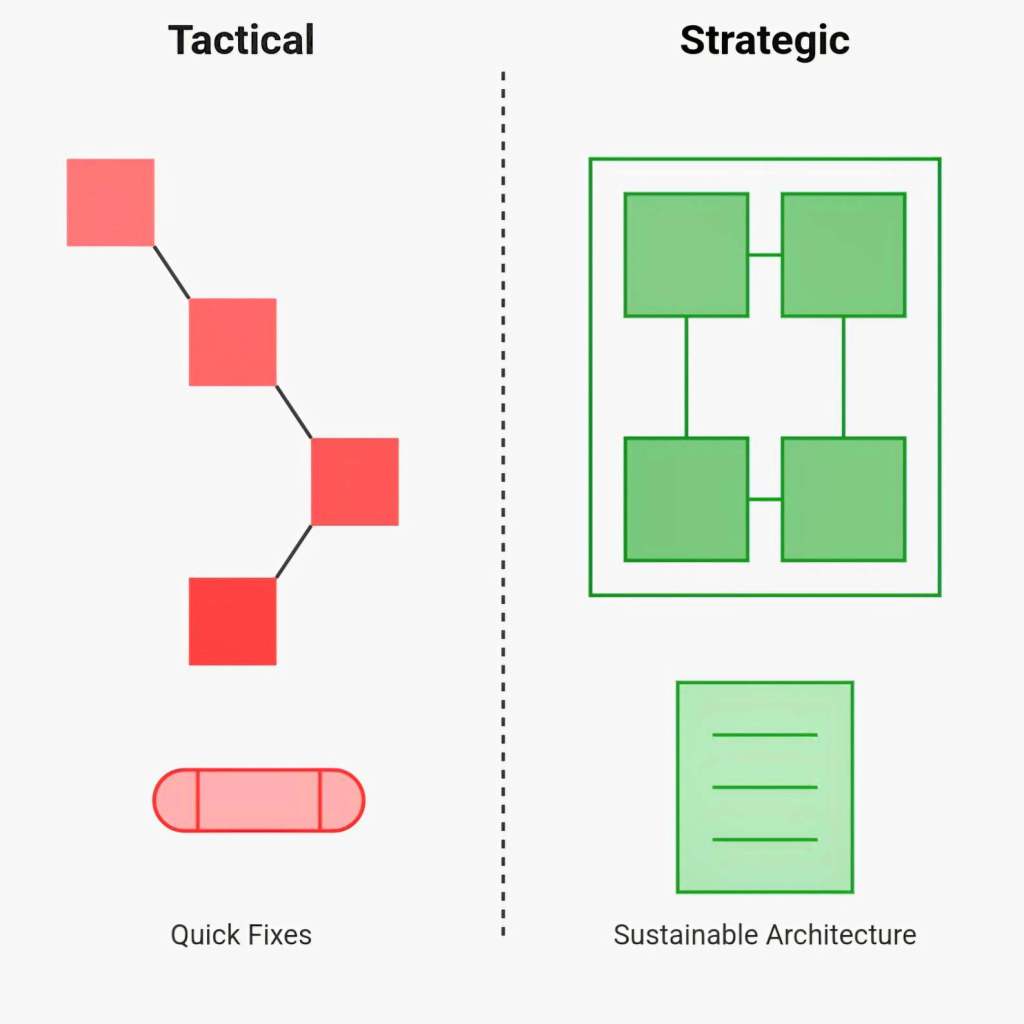
Software engineering involves a continuous balance between tactical and strategic programming approaches. Tactical programming emphasizes immediate solutions to pressing issues, whereas strategic programming prioritizes long-term sustainability and the overall health of the system. This essay examines why strategic programming typically results in superior outcomes and provides guidance for development teams transitioning to more strategic methodologies.
The Tactical Approach
Tactical programming is defined by its responsiveness. Similar to a tactical maneuver in the military, it addresses the immediate challenges using the available tools. Developers employing a tactical approach often:
- Write code solely to resolve the present issue
- Take shortcuts to meet urgent deadlines
- Accumulate technical debt to expedite results
- Concentrate on making features operational rather than maintainable
- Forego documentation and testing in favor of deploying code
While this approach is sometimes necessary, particularly in emergencies, critical production fixes, or developing proof-of-concept prototypes, relying on it as the primary strategy can lead to significant long-term challenges.
The Strategic Approach
Strategic programming adopts a broader perspective, considering not only the immediate issue but also how the solution integrates into the overall system architecture and its implications for future development. Strategic programmers:
- Design flexible and extensible solutions
- Allocate time for proper architecture and system design
- Produce thorough tests and documentation
- Regularly refactor to uphold code quality
- Anticipate future maintenance and modification requirements
- Create reusable components and abstractions
Although strategic programming demands a greater initial investment, it often leads to better long-term results for several reasons:
1. Reduction of Technical Debt
Strategic programming actively mitigates the accumulation of technical debt. In contrast to tactical methods that incur debt requiring eventual repayment with interest, strategic solutions promote ongoing system health. This results in more predictable development timelines and fewer unforeseen delays.
2. Enhanced Maintainability
Code developed with a strategic focus is inherently more maintainable. A clear architecture, comprehensive documentation, and robust tests facilitate easier understanding and modification of code for both current and future developers, thereby reducing the time and risk associated with subsequent changes.
3. Increased Scalability
Strategic solutions are typically more scalable in terms of system performance and team collaboration. Well-designed abstractions and interfaces simplify functionality extensions, while a clear architectural framework allows multiple developers to contribute simultaneously to the system.
4. Decreased Long-term Costs
While implementing strategic programming may require higher initial investments, it generally results in lower costs over time. Improved maintainability fosters quicker feature development and fewer bugs, while reduced technical debt minimizes the need for emergency fixes and rewrites.
Transitioning Towards Strategic Programming
To adopt more strategic programming practices, development teams can:
1. Allocate Time for Design
Ensure sufficient time is dedicated to system design prior to implementation. This includes documenting requirements, exploring alternative approaches, and planning for future extensibility. It is essential to resist the impulse to begin coding immediately.
2. Set Clear Architectural Guidelines
Establish and maintain clear architectural guidelines for the system. These should encompass coding standards, recommended design patterns, and best practices for common scenarios. Ensure that these guidelines are readily accessible to all team members.
3. Implement Comprehensive Review Processes
Establish thorough code review processes that assess not only functionality but also design decisions, maintainability, and compliance with architectural standards. Use these reviews as opportunities for mentoring and knowledge sharing among team members.
4. Prioritize Testing and Documentation
Ensure that thorough testing and documentation are integral components of the development process. This includes unit tests, integration tests, and clear documentation of both implementation specifics and architectural decisions.
5. Schedule Regular Refactoring
Designate regular intervals for refactoring to maintain code quality and prevent the accumulation of technical debt. Treat this as a standard component of the development process rather than an exceptional task.
6. Cultivate Team Culture
Promote a team culture that prioritizes quality and maintainability. Recognize effective design decisions and clean code with the same enthusiasm as shipping features. Encourage team members to appreciate the long-term benefits associated with strategic programming.
Conclusion
Although tactical programming has its place in certain scenarios, strategic programming is generally the preferred approach for sustainable software development. It fosters the creation of more maintainable, scalable systems with lower long-term costs. By instituting robust architectural practices, investing in quality outcomes, and cultivating an appropriate team culture, organizations can transition more effectively toward strategic development practices.
Finding the right balance is crucial—recognizing when tactical solutions are suitable while maintaining a strategic mindset as the default position. This equilibrium, combined with a consistent commitment to sound practices, leads to improved outcomes for both developers and stakeholders.
 Software Engineering on the Spectrum