Introduction
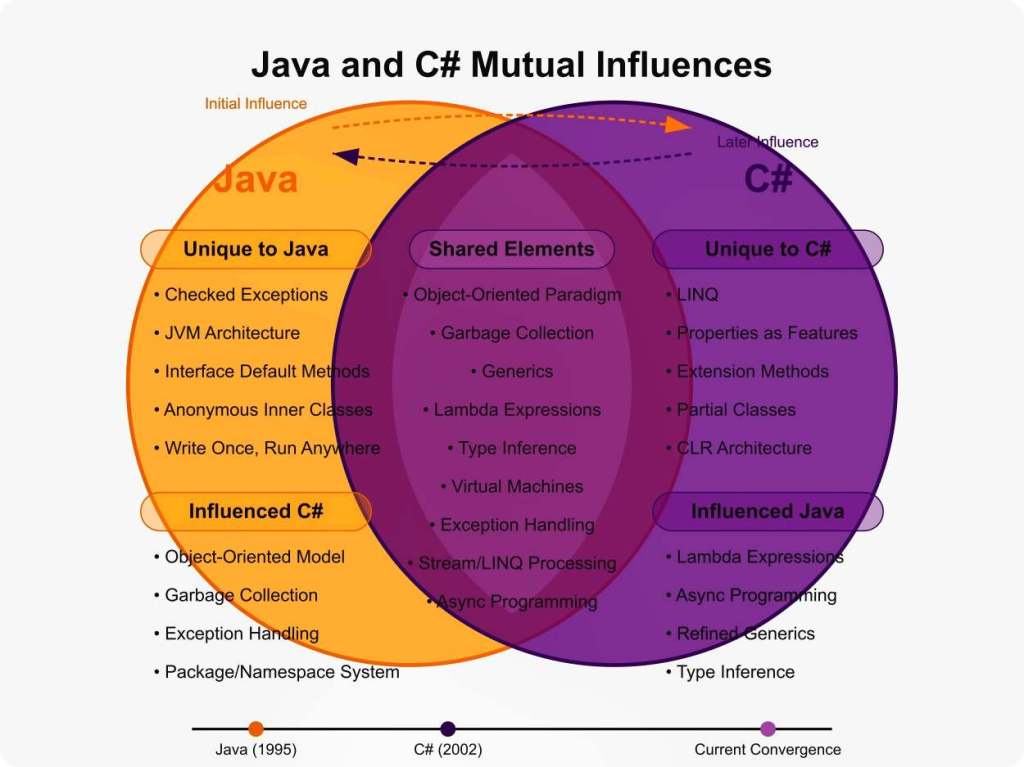
Java and C# are among the most prominent programming languages in contemporary software development. Java was developed by Sun Microsystems, now part of Oracle, in the mid-1990s, while C# was introduced by Microsoft in the early 2000s as an element of its .NET framework. The interplay between these languages offers a compelling case study in the evolution of programming language design, shaped by both competition and collaborative inspiration.
This document analyzes the technical characteristics that each language has adopted from the other, investigates their parallel development, and includes concrete code examples to demonstrate these shared concepts. Gaining an understanding of these influences sheds light on not only the languages themselves but also the broader trends in programming language design.
Java’s Influence on C#
1. Fundamentals of Object-Oriented Programming
C# embraced Java’s core object-oriented principles, which were originally influenced by C++. Both languages emphasize:
- The concept of everything being an object (excluding primitive types)
- Single inheritance coupled with multiple interface implementations
- Automatic garbage collection for memory management
// Java

// Base class
public class Animal {
    protected String name;

    public Animal(String name) {
        this.name = name;
    }

    public void makeSound() {
        System.out.println("Some generic sound");
    }
}

// Interface
public interface Pet {
    void play();
}

// Derived class with interface implementation
public class Dog extends Animal implements Pet {
    public Dog(String name) {
        super(name);
    }

    @Override
    public void makeSound() {
        System.out.println("Woof!");
    }

    @Override
    public void play() {
        System.out.println(name + " plays fetch!");
    }
}
// C#

// Base class
public class Animal {
    protected string name;

    public Animal(string name) {
        this.name = name;
    }

    public virtual void MakeSound() {
        Console.WriteLine("Some generic sound");
    }
}

// Interface
public interface IPet {
    void Play();
}

// Derived class with interface implementation
public class Dog : Animal, IPet {
    public Dog(string name) : base(name) {
    }

    public override void MakeSound() {
        Console.WriteLine("Woof!");
    }

    public void Play() {
        Console.WriteLine($"{name} plays fetch!");
    }
}
2. Runtime Environment
C# adopted Java’s “write once, run anywhere” philosophy, though with different implementation frameworks:
- Java: Java Virtual Machine (JVM)
- C#: Common Language Runtime (CLR)
Both languages compile to an intermediate bytecode, facilitating platform independence.
3. Exception Handling
C# integrated Java’s exception handling model almost directly:
// Java

public void readFile(String path) {
    try {
        BufferedReader reader = new BufferedReader(new FileReader(path));
        String line = reader.readLine();
        System.out.println(line);
        reader.close();
    } catch (FileNotFoundException e) {
        System.err.println("File not found: " + e.getMessage());
    } catch (IOException e) {
        System.err.println("Error reading file: " + e.getMessage());
    } finally {
        System.out.println("Execution finished");
    }
}
// C#

public void ReadFile(string path) {
    try {
        using (StreamReader reader = new StreamReader(path)) {
            string line = reader.ReadLine();
            Console.WriteLine(line);
        }
    } catch (FileNotFoundException e) {
        Console.Error.WriteLine("File not found: " + e.Message);
    } catch (IOException e) {
        Console.Error.WriteLine("Error reading file: " + e.Message);
    } finally {
        Console.WriteLine("Execution finished");
    }
}
4. Package System
C# adopted Java’s concept of namespaces (referred to as “packages” in Java) for code organization:
// Java

package com.example.utilities;

public class StringHelper {
    public static String reverse(String input) {
        return new StringBuilder(input).reverse().toString();
    }
}

// Using it elsewhere
import com.example.utilities.StringHelper;

public class Main {
    public static void main(String[] args) {
        System.out.println(StringHelper.reverse("Hello"));
    }
}
// C#

namespace Com.Example.Utilities {
    public class StringHelper {
        public static string Reverse(string input) {
            char[] charArray = input.ToCharArray();
            Array.Reverse(charArray);
            return new string(charArray);
        }
    }
}

// Using it elsewhere
using Com.Example.Utilities;

public class Program {
    public static void Main(string[] args) {
        Console.WriteLine(StringHelper.Reverse("Hello"));
    }
}
C#’s Influence on Java
While C# initially drew extensively from Java, Java has since adopted several features that were first implemented in C#:
1. Generics
Both languages incorporated generics to facilitate type-safe collections and algorithms, with C#’s implementation influencing later improvements in Java:
// C#

public class Stack<T> {
    private T[] elements;
    private int size = 0;

    public Stack() {
        elements = new T[10];
    }

    public void Push(T item) {
        if (size == elements.Length) {
            T[] newElements = new T[elements.Length * 2];
            Array.Copy(elements, newElements, elements.Length);
            elements = newElements;
        }
        elements[size++] = item;
    }

    public T Pop() {
        if (size == 0) {
            throw new InvalidOperationException("Stack is empty");
        }
        return elements[--size];
    }
}

// Usage
Stack<int> intStack = new Stack<int>();
intStack.Push(42);
int value = intStack.Pop();
// Java

public class Stack<T> {
    private Object[] elements;
    private int size = 0;

    public Stack() {
        elements = new Object[10];
    }

    public void push(T item) {
        if (size == elements.length) {
            Object[] newElements = new Object[elements.length * 2];
            System.arraycopy(elements, 0, newElements, 0, elements.length);
            elements = newElements;
        }
        elements[size++] = item;
    }

    @SuppressWarnings("unchecked")
    public T pop() {
        if (size == 0) {
            throw new EmptyStackException();
        }
        T item = (T) elements[--size];
        elements[size] = null; // Help garbage collection
        return item;
    }
}

// Usage
Stack<Integer> intStack = new Stack<Integer>();
intStack.push(42);
int value = intStack.pop();
2. Lambda Expressions and Functional Interfaces
C# introduced lambda expressions in 2007, while Java added them in Java 8 (2014):
// C#

List<int> numbers = new List<int> { 1, 2, 3, 4, 5 };
var evenNumbers = numbers.Where(n => n % 2 == 0);

foreach (var num in evenNumbers) {
    Console.WriteLine(num);
}
// Java

List<Integer> numbers = Arrays.asList(1, 2, 3, 4, 5);
List<Integer> evenNumbers = numbers.stream()
                                  .filter(n -> n % 2 == 0)
                                  .collect(Collectors.toList());

for (Integer num : evenNumbers) {
    System.out.println(num);
}
3. Properties
// C#

List<int> numbers = new List<int> { 1, 2, 3, 4, 5 };
var evenNumbers = numbers.Where(n => n % 2 == 0);

foreach (var num in evenNumbers) {
    Console.WriteLine(num);
}
// Java

List<Integer> numbers = Arrays.asList(1, 2, 3, 4, 5);
List<Integer> evenNumbers = numbers.stream()
                                  .filter(n -> n % 2 == 0)
                                  .collect(Collectors.toList());

for (Integer num : evenNumbers) {
    System.out.println(num);
}
C# introduced properties as a first-class feature in the language. Java later adopted a similar concept with JavaBeans conventions, though not as succinctly:
// C#

public class Person {
    private string _name;
    private int _age;

    // Auto-implemented property
    public string Email { get; set; }

    // Property with backing field
    public string Name {
        get { return _name; }
        set { _name = value; }
    }

    // Property with validation
    public int Age {
        get { return _age; }
        set {
            if (value < 0) {
                throw new ArgumentException("Age cannot be negative");
            }
            _age = value;
        }
    }
}

// Usage
Person person = new Person();
person.Name = "John";
person.Age = 30;
Console.WriteLine(person.Name); // "John"
// Java

public class Person {
    private String name;
    private int age;
    private String email;

    // Getters and setters (JavaBeans convention)
    public String getName() {
        return name;
    }

    public void setName(String name) {
        this.name = name;
    }

    public int getAge() {
        return age;
    }

    public void setAge(int age) {
        if (age < 0) {
            throw new IllegalArgumentException("Age cannot be negative");
        }
        this.age = age;
    }

    public String getEmail() {
        return email;
    }

    public void setEmail(String email) {
        this.email = email;
    }
}

// Usage
Person person = new Person();
person.setName("John");
person.setAge(30);
System.out.println(person.getName()); // "John"
4. Async/Await Pattern
C# pioneered the async/await pattern for asynchronous programming, which Java later incorporated in various forms:
// C#

public async Task<string> FetchWebPageAsync(string url) {
    HttpClient client = new HttpClient();
    string result = await client.GetStringAsync(url);
    return result;
}

// Usage
async Task ProcessDataAsync() {
    string data = await FetchWebPageAsync("https://example.com");
    Console.WriteLine(data.Length);
}
// Java

public CompletableFuture<String> fetchWebPageAsync(String url) {
    return CompletableFuture.supplyAsync(() -> {
        try {
            HttpClient client = HttpClient.newHttpClient();
            HttpRequest request = HttpRequest.newBuilder()
                .uri(URI.create(url))
                .build();
            HttpResponse<String> response = client.send(request, HttpResponse.BodyHandlers.ofString());
            return response.body();
        } catch (Exception e) {
            throw new CompletionException(e);
        }
    });
}

// Usage
public void processData() {
    fetchWebPageAsync("https://example.com")
        .thenAccept(data -> System.out.println(data.length()));
}
Convergent Evolution
Both languages have developed in parallel, frequently implementing similar features as a response to shifting programming paradigms:
1. Type Inference
Both languages have introduced type inference capabilities, promoting more concise code:
// C#

// Before type inference
Dictionary<string, List<int>> map = new Dictionary<string, List<int>>();

// After type inference (C# 3.0+)
var map = new Dictionary<string, List<int>>();
// Java

// Before type inference
HashMap<String, List<Integer>> map = new HashMap<String, List<Integer>>();

// After type inference (Java 7+)
HashMap<String, List<Integer>> map = new HashMap<>();

// After var (Java 10+)
var map = new HashMap<String, List<Integer>>();
2. Stream/LINQ for Collection Processing
Both languages have embraced functional approaches to collection manipulation:
// C#

List<Person> people = GetPeople();

var adults = people.Where(p => p.Age >= 18)
                   .OrderBy(p => p.LastName)
                   .ThenBy(p => p.FirstName)
                   .Select(p => new { FullName = $"{p.FirstName} {p.LastName}", p.Age });

foreach (var person in adults) {
    Console.WriteLine($"{person.FullName} is {person.Age} years old");
}
// Java

List<Person> people = getPeople();

people.stream()
      .filter(p -> p.getAge() >= 18)
      .sorted(Comparator.comparing(Person::getLastName)
                       .thenComparing(Person::getFirstName))
      .map(p -> Map.of("fullName", p.getFirstName() + " " + p.getLastName(),
                       "age", p.getAge()))
      .forEach(person -> System.out.println(person.get("fullName") +
                                          " is " + person.get("age") + " years old"));
Unique Features in Each Language
While considerable cross-pollination has occurred between Java and C#, each language retains its unique characteristics:
Unique to C#
- LINQ (Language Integrated Query): Although Java’s Stream API provides similar functionality, LINQ’s integration is more profound.
- Properties: Support as a first-class language feature for encapsulation.
- Extension Methods: Enable the addition of methods to existing types without modifying them.
public static class StringExtensions {
    public static bool IsPalindrome(this string str) {
        string reversed = new string(str.ToCharArray().Reverse().ToArray());
        return str.Equals(reversed, StringComparison.OrdinalIgnoreCase);
    }
}

// Usage
bool isPalindrome = "radar".IsPalindrome(); // true
- Partial Classes: Allow a class to be defined across multiple files.
Unique to Java
- Checked Exceptions: Mandate the handling of exceptions at compile time.
public void readFile(String path) throws IOException {
    BufferedReader reader = new BufferedReader(new FileReader(path));
    // Code that might throw IOException
}

// Caller must handle the exception
public void processFile() {
    try {
        readFile("data.txt");
    } catch (IOException e) {
        e.printStackTrace();
    }
}
- Anonymous Inner Classes: More versatile than C#’s anonymous delegates (though less necessary with the advent of lambdas).
- Interface Default Methods: Facilitate the addition of implemented methods to interfaces (introduced in Java 8).
public interface Vehicle {
    void accelerate();

    default void honk() {
        System.out.println("Beep beep!");
    }
}

// Implementation only needs to implement non-default methods
public class Car implements Vehicle {
    @Override
    public void accelerate() {
        System.out.println("Car is accelerating");
    }

    // Can use default honk() or override it
}
Conclusion
The interaction between Java and C# exemplifies how programming languages can develop through both competitive and cooperative influences. Initially, C# borrowed extensively from Java’s foundational object-oriented principles and runtime methodologies. However, as both languages matured, the influence became reciprocal. Innovations from C#, such as properties, async/await patterns, and enhanced generics, have significantly impacted Java’s ongoing evolution.
Currently, both languages continue to adapt to contemporary programming paradigms by integrating functional programming features, improving type systems, and enhancing syntax clarity. Their parallel evolution signifies how effective design ideas in programming language development tend to traverse language boundaries, ultimately benefiting developers irrespective of their preferred platforms.
Understanding these shared influences and distinct trajectories enables developers to appreciate the underlying design motivations in both languages, facilitating smoother transitions between Java and C# projects. While each language sustains its diverse ecosystem and strengths, the commonality between them continues to expand, reflecting a convergence on effective language design for enterprise-scale application development.
 Software Engineering on the Spectrum