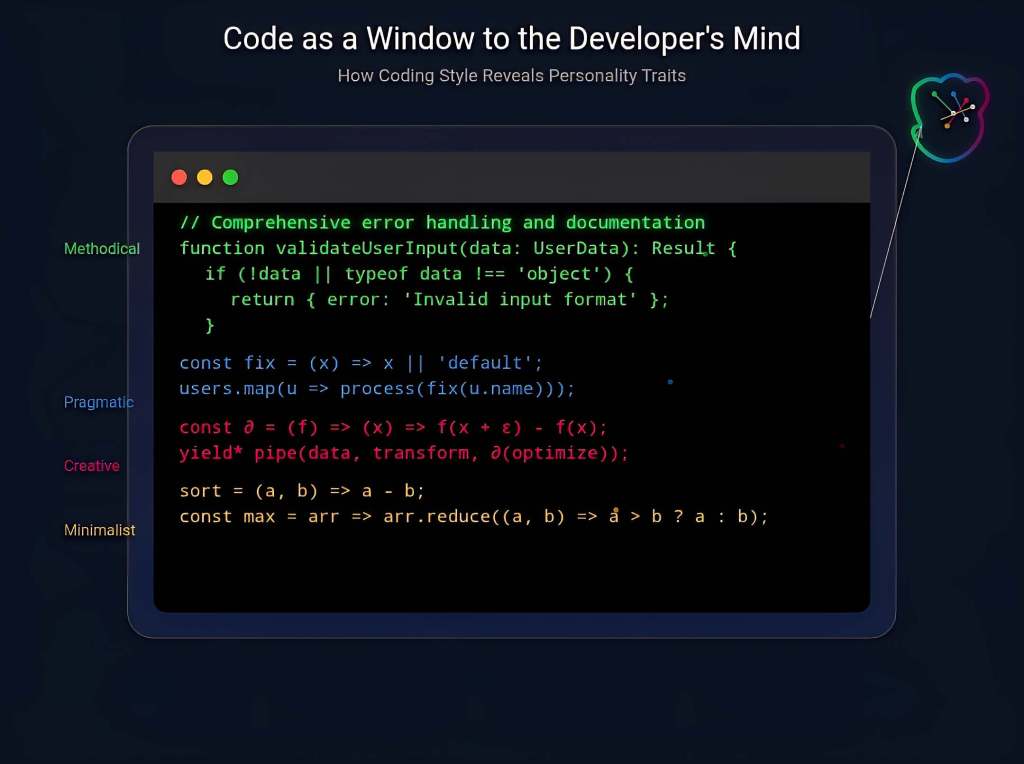
The coding style of a software engineer serves as a distinct identifier, illustrating more than just technical proficiency. Much like handwriting analysis aims to reveal personality traits, the examination of coding patterns, architectural choices, and programming practices can provide valuable insights into the psychological characteristics of developers. While these correlations may not be scientifically conclusive, they offer significant perspectives for enhancing team dynamics, making informed hiring decisions, and fostering individual growth within software engineering.
The Methodical Architect: Attention to Detail and Conscientiousness
Engineers who consistently produce clean, well-documented code, accompanied by thorough comments, often display high levels of conscientiousness. Their functions are aptly named, variables adhere to clear conventions, and they diligently address every edge case. These developers typically engage in extensive planning before coding, create detailed specifications, and avoid rushed implementations in favor of thorough analysis.
Such meticulous coding behaviors often align with personalities that prioritize order, reliability, and strategic thinking. These engineers excel in roles that require system architecture, critical infrastructure development, or projects emphasizing maintenance and scalability. Their code remains robust over time, allowing future developers to comprehend and build upon their work with ease.
Nevertheless, this meticulousness can sometimes lead to perfectionism, resulting in over-engineering or analysis paralysis. These developers may invest excessive time optimizing code that does not require such attention or crafting elaborate abstractions for straightforward problems.
The Pragmatic Problem-Solver: Practicality and Results Orientation
In contrast to the methodical architect, some engineers prioritize functionality over form in their coding. Their approaches are straightforward, often lacking extensive documentation but clearly demonstrating logical problem-solving. These developers typically embody practical personalities, emphasizing the delivery of functional solutions rather than striving for perfection.
This coding style is indicative of individuals who thrive under pressure, quickly adapt to changing requirements, and value practical outcomes over theoretical elegance. Such engineers are particularly effective in startup environments, rapid prototyping, or situations where speed to market is crucial. While their code may appear less polished, it reliably addresses the intended challenges with efficiency.
However, the potential downside lies in the accumulation of technical debt. Although their immediate solutions are effective, the lack of long-term considerations may result in maintenance difficulties as systems expand and evolve.
The Creative Innovator: Openness and Experimentation
Engineers who frequently engage with new technologies, unconventional methods, or innovative design patterns typically exhibit a high level of openness to experience. Their code repositories may reflect diverse programming languages, leading-edge frameworks, or unique architectural solutions that others might deem risky or unnecessary.
These developers often demonstrate intellectual curiosity, creativity, and comfort with ambiguity. They tend to be early adopters of new technologies and can offer valuable insights into emerging trends. Their willingness to explore new frontiers makes them well-suited for research and development roles or projects requiring innovative solutions.
However, their inclination towards novelty might sometimes introduce unnecessary complexity or select cutting-edge technologies that lack widespread community support or long-term viability.
The Collaborative Communicator: Extroversion and Team Orientation
Code that is structured with an intention for team collaboration often reflects extroverted, teamwork-oriented personalities. These engineers invest effort into crafting detailed README files, providing helpful comments that clarify not only the “what” but also the “why,” and organizing their code for easy review and comprehension by team members.
Their commit messages narrate a story, their variable names convey clarity, and their code reviews provide constructive, detailed feedback. These patterns indicate individuals who consider their work within the larger context of team dynamics and long-term project objectives.
Such developers are likely to gravitate towards leadership roles, mentoring opportunities, or positions that entail significant cross-functional collaboration. Their code functions as a communication tool, linking technical implementation with broader project ambitions.
The Efficiency Optimizer: Competitiveness and Performance Focus
Engineers who consistently optimize for performance, memory usage, or computational efficiency often exhibit competitive personalities with a strong focus on achievement. Their code may incorporate sophisticated algorithms, clever optimizations, or deep system-level considerations that might be overlooked by others.
These developers typically thrive on challenges, enjoy competitive programming, and are drawn to situations where technical excellence yields clear advantages. They possess substantial technical knowledge and take pride in crafting elegant, efficient solutions to complex problems.
The challenge arises when they engage in premature optimization or over-engineer solutions when simpler alternatives would suffice. Their emphasis on technical perfection might occasionally overshadow user needs or broader business objectives.
The Risk-Averse Guardian: Neuroticism and Defensive Programming
Developers who write highly defensive code with extensive error handling, input validation, and fail-safe mechanisms may demonstrate higher levels of neuroticism or anxiety. Their code preemptively addresses potential failures, rigorously validates assumptions, and incorporates multiple contingency strategies.
This coding style can produce robust, reliable systems capable of gracefully handling edge cases. These engineers excel in fields that require critical systems development, security-focused roles, or environments where system failures carry significant consequences.
However, excessive defensive programming may result in code bloat, diminished readability, or overly complex solutions for straightforward scenarios. The challenge lies in balancing appropriate caution with practical development demands.
The Minimalist Philosopher: Simplicity and Elegance
Some engineers consistently generate concise, elegant code that fulfills complex tasks with minimal complexity. This approach reflects personalities that value simplicity, clarity, and philosophical elegance in their problem-solving strategies.
These developers demonstrate strong analytical thinking, patience, and discernment in recognizing essential patterns within intricate requirements. Their solutions tend to be maintainable, understandable, and resilient against feature creep or unnecessary complications.
The potential limitation arises when extreme minimalism compromises essential functionality or fails to account for future requirements that may necessitate additional complexity.
Cultural and Environmental Influences
It is important to acknowledge that coding style is not solely dictated by personality traits. Cultural background, educational experiences, team dynamics, project requirements, and time constraints significantly influence how engineers write code. A developer may exhibit varying coding patterns across different projects or stages in their career, reflecting shifting contexts rather than intrinsic personality changes.
Furthermore, contemporary development practices such as code reviews, automated formatting tools, and team coding standards can obscure or modify individual stylistic preferences, complicating the inference of personality traits while still allowing for analysis.
Implications for Team Management and Hiring
Awareness of the correlations between coding style and personality can enhance team composition, project assignments, and professional development strategies. Recognizing that various personality types contribute distinct strengths to software development aids in creating well-balanced, effective teams.
For hiring managers, evaluating code samples in conjunction with traditional interviews can yield additional insights into a candidate’s suitability for specific roles or team dynamics. Nonetheless, this analysis should complement, rather than replace, direct assessments of personality and cultural fit.
Limitations and Considerations
While these correlations provide intriguing insights, they should be approached judiciously. Coding style is influenced by multiple factors beyond personality, including experience level, domain requirements, time constraints, and learned practices. Additionally, individuals may consciously adjust their coding style based on context or feedback, potentially concealing underlying personality traits.
Moreover, personality is inherently complex and multifaceted. A single coding sample may reveal certain tendencies while masking others. A comprehensive personality assessment necessitates multiple data points and observations across varied contexts.
Conclusion
Analyzing coding style serves as a lens through which to understand a software engineer’s personality, offering valuable insights for optimizing team dynamics, project assignments, and individual growth. While these insights may not be scientifically definitive, they furnish useful frameworks for appreciating diverse engineering approaches and their foundational motivations.
Recognizing diversity in coding styles as a reflection of diverse cognitive patterns enriches the software development process. Rather than positioning styles as superior or inferior, effective teams leverage these differences to develop more resilient, innovative, and maintainable software solutions.
Ultimately, understanding these connections fosters a more empathetic and effective software development environment, allowing diverse personality types to contribute their unique strengths while transcending their inherent limitations. In an industry increasingly valuing both technical excellence and human collaboration, this personality-aware approach to coding style analysis becomes an indispensable asset for developing superior software and stronger teams.
 Software Engineering on the Spectrum