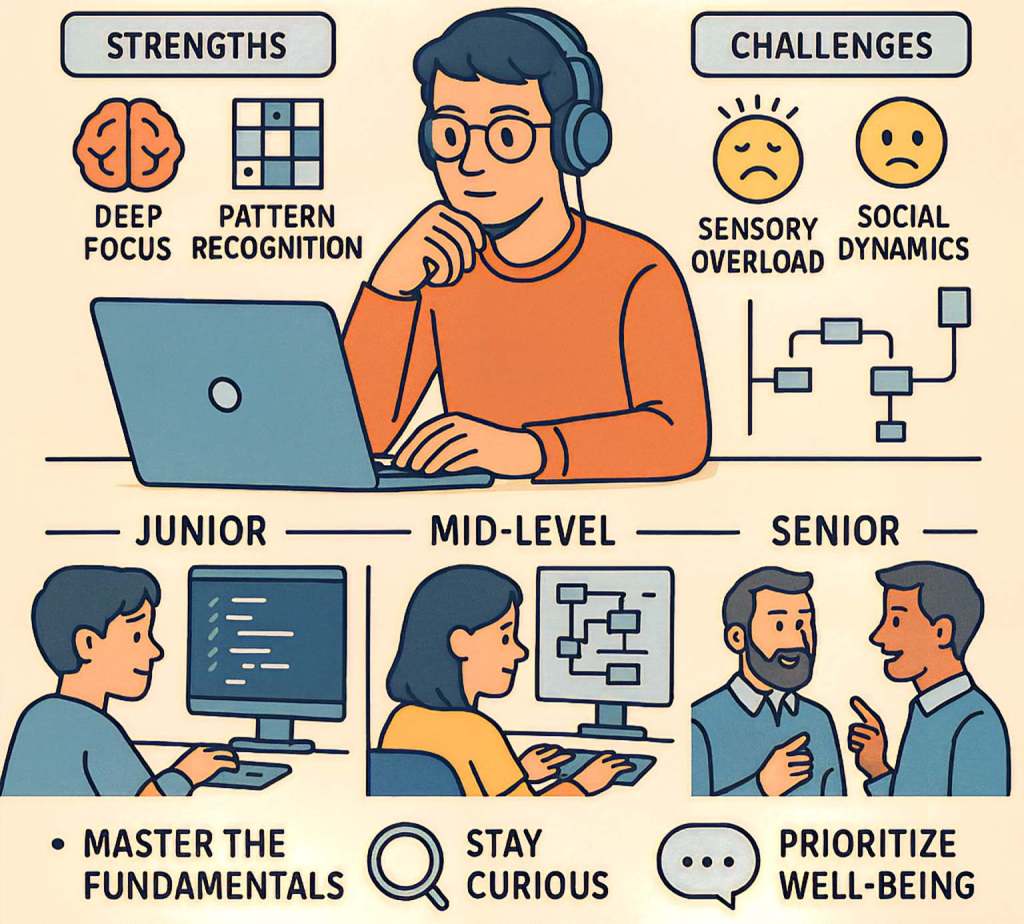
As a software engineer with a high level of intelligence and an autism spectrum disorder (ASD) diagnosis, I have successfully navigated the complexities of the tech industry by leveraging my strengths—intense focus, pattern recognition, and a commitment to precision—while adapting to challenges such as social dynamics and sensory sensitivities. Achieving success in software engineering necessitates technical expertise, continuous learning, and resilience, regardless of neurodiversity or cognitive profile. Below, I provide practical advice for software engineers at all levels—junior, mid-level, and senior—to help you thrive in this rewarding yet demanding field. These insights combine my personal experiences with universal principles aimed at empowering engineers to excel technically, professionally, and personally.
Master the Fundamentals, Then Specialize Strategically
For All Levels: A robust understanding of computer science fundamentals—data structures, algorithms, system design, and programming paradigms—is essential. These foundational concepts are critical for effective problem-solving, whether debugging intricate issues or architecting complex systems. In the early stages of my career, my ability to tackle complex problems using foundational principles provided me with a clear advantage, even when my domain-specific knowledge was limited.
Junior Engineers: Invest time in mastering core concepts, such as arrays, linked lists, trees, sorting algorithms, and time/space complexity (Big-O notation). Resources like *Introduction to Algorithms* by Cormen or online platforms like LeetCode and HackerRank can reinforce your skills. Focus on writing clean, efficient code in at least one programming language (e.g., Python, Java, or C++). Strive to understand the underlying principles behind solutions, rather than just memorizing them.
Mid-Level Engineers: Enhance your expertise in a specific area, such as backend development, machine learning, or DevOps. For instance, if you are interested in systems programming, delve into low-level concepts like memory management or concurrency. My drive for intense focus allowed me to master niche areas such as compiler optimization, but choose a specialization that aligns with your interests and market demands.
Senior Engineers: Maintain a broad understanding of cross-functional systems (e.g., how front-end applications interact with backend services or the integration of CI/CD pipelines) while developing deep expertise in your specialization. Mentor junior engineers by breaking down complex concepts into digestible parts, utilizing your capacity for identifying patterns that others may overlook.
Pro Tip: Engineers with high intelligence often excel at identifying inefficiencies in code or systems. Leverage this ability by refactoring legacy code or suggesting architectural enhancements, but balance the pursuit of perfection with practical deadlines—aim to release code that meets requirements without being overly meticulous.
Embrace Continuous Learning and Adaptability
The technology landscape is in constant flux, with new frameworks, languages, and paradigms emerging regularly. While my intelligence drives natural curiosity, ASD can render change overwhelming. Here’s how to remain adaptable at any level:
Junior Engineers: Cultivate a daily learning habit. Dedicate 30–60 minutes to studying a new tool, framework, or concept. For example, web developers should explore modern frameworks like React or Node.js. Utilize resources such as freeCodeCamp, Coursera, or YouTube channels like Fireship to stay updated. Embrace failure as a learning opportunity—early mistakes contribute to your growth.
Mid-Level Engineers: Concentrate on mastering instruments that are critical to your role, such as Docker for containerization or Kubernetes for orchestration. Undertake side projects to delve into emerging technologies like AI, blockchain, or serverless computing. My structured approach to learning, influenced by ASD, involves creating detailed plans—set SMART goals (Specific, Measurable, Achievable, Relevant, Time-bound) to monitor your progress.
Senior Engineers: Stay informed about industry trends by reading research papers, attending conferences (either virtually or in-person), or contributing to open-source projects. Lead by example: share your knowledge through blog posts, presentations, or internal documentation. Engineers with high IQs often discern connections others may overlook; use this insight to inform your team of future industry developments and opportunities.
Pro Tip: Develop a personalized learning system. Tools like Notion can help organize resources and track progress, mitigating the sensory overload associated with excessive information—a common challenge for those with ASD.
Develop Effective Communication and Collaboration Skills
Software engineering is inherently collaborative, and communication can be challenging, particularly for individuals with ASD who may struggle with social cues or prefer solitary work. My heightened intelligence allows me to process information quickly, yet I have actively worked to build my interpersonal skills to thrive in team environments.
Junior Engineers: Practice clear and concise communication. When posing questions, provide context (e.g., “I’m debugging a null pointer exception in this function—here’s the code”). Listen actively during code reviews and stand-up meetings. If social interactions feel daunting, prepare scripts for common scenarios, such as explaining your work in a sprint demo.
Mid-Level Engineers: Act as a bridge between technical and non-technical stakeholders by translating complex concepts into relatable terms for product managers or designers. If ASD makes attending meetings overwhelming, request agendas in advance or suggest asynchronous updates via tools like Slack. I have found that clear written communication (e.g., detailed pull request descriptions) minimizes misunderstandings.
Senior Engineers: Lead with empathy. Provide constructive feedback to junior engineers that is specific and actionable (e.g., “Consider using a hash map here to reduce lookup time from O(n) to O(1)”). Advocate for your team’s needs in cross-functional discussions. If sensory sensitivities render open-plan offices challenging, negotiate for remote work options or use noise-canceling headphones.
Pro Tip: Engineers with high IQs often excel in written communication due to their precision. Utilize this strength by documenting processes, writing clear specifications, or contributing to Requests for Comments (RFCs). If verbal communication presents challenges, practice with a trusted colleague or use tools like Loom to record explanations.
Prioritize Problem-Solving and Systems Thinking
My analytical abilities and ASD-driven pattern recognition position me as a natural problem solver. However, I have learned to balance in-depth exploration with practical delivery. Software engineering focuses on efficiently addressing real-world problems rather than merely pursuing intellectual challenges.
Junior Engineers: Decompose problems into smaller, manageable components. For example, if tasked with optimizing a slow API, begin by profiling the code to identify bottlenecks and test incremental improvements. Utilize debugging tools such as breakpoints or logging to systematically trace issues.
Mid-Level Engineers: Adopt a holistic perspective of systems. Understand how your code integrates within the broader architecture, such as the impacts of a database query on latency or the effects of caching on scalability. My capacity for hyperfocus aids me in identifying issues across microservices, yet it is essential to validate assumptions with data (e.g., metrics from tools like New Relic).
Senior Engineers: Design solutions that effectively balance trade-offs (e.g., speed versus maintainability). Leverage your pattern recognition to anticipate potential failure modes—such as scalability challenges when a service expands significantly. Lead post-mortem analyses to learn from outages, concentrating on root causes rather than placing blame.
Pro Tip: Engineers with high IQs may tend to overcomplicate solutions. Regularly ask yourself, “What is the simplest approach that meets the requirements?” Utilize frameworks such as the 80/20 rule to concentrate on high-impact tasks.
Manage Burnout and Sensory Overload
The fast-paced nature of the tech environment can be overwhelming, especially for individuals with ASD, due to constant context-switching, noisy workplaces, and tight deadlines. Individuals with high intelligence may also push themselves excessively, aiming for perfection. Here’s how to maintain a sustainable pace:
Junior Engineers: Establish boundaries early on. If meetings or open-plan offices contribute to sensory overload, discuss accommodations with your manager (e.g., flexible hours or designated quiet areas). Implement time-blocking techniques to focus on coding without distractions.
Mid-Level Engineers: Be attentive to signs of burnout, such as irritability or diminished focus. Take regular breaks to recharge—short walks or mindfulness exercises can be beneficial. I have discovered that maintaining routine, a hallmark of ASD, enhances my productivity; create a consistent schedule for deep work as well as rest.
Senior Engineers: Promote team-wide wellness initiatives, such as designated no-meeting days or well-defined on-call rotations. Model healthy behaviors by taking vacations and encouraging team members to do the same. If mentoring feels taxing, consider structuring sessions to limit their frequency and scope.
Pro Tip: Utilize tools like noise-canceling headphones or Pomodoro timers to help manage sensory and cognitive loads. Communicate your needs clearly; most teams are open to accommodations when the benefits for overall performance are explained.
Build a Personal Brand and Network Authentically
A strong personal brand and network can significantly enhance your career, although networking may feel unnatural for individuals with ASD. My intelligence allows me to contribute unique insights, which I have used to establish credibility without the need for forced social interactions.
Junior Engineers: Share your work through low-pressure channels, such as internal wikis or GitHub repositories. Seek constructive feedback from trusted colleagues to bolster your confidence. Attend local meetups or virtual events, and prepare questions in advance to alleviate social anxiety.
Mid-Level Engineers: Contribute to open-source projects or compose blog posts on problems you have addressed (e.g., “How I Optimized a Database Query by 50%”). This practice highlights your expertise and can attract new opportunities. If face-to-face networking is challenging, engage thoughtfully on platforms like X or LinkedIn.
Senior Engineers: Position yourself as a thought leader by speaking at conferences, publishing articles, or providing mentorship through public platforms (e.g., via ADPList). Use your unique pattern recognition to identify opportunities within the industry and propose innovative solutions. Cultivate relationships by offering value rather than simply seeking it.
Pro Tip: For individuals with ASD, online communities such as Stack Overflow or specialized Discord groups can present a less overwhelming alternative to in-person events. Share your knowledge generously to build trust and visibility within these communities.
Leverage Your Unique Strengths
Individuals with high intelligence and ASD often possess strengths such as hyperfocus, attention to detail, and unconventional problem-solving abilities. Embrace these strengths while finding strategies to navigate associated challenges:
Hyperfocus: Utilize your capability for deep concentration on high-impact tasks such as debugging complex problems or exploring new technologies. Set time limits to prevent losing track of time.
Pattern Recognition: Harness your skill in identifying patterns to locate bugs, optimize code, or anticipate system failures. Document these insights for sharing with your team.
– **Attention to Detail**: Ensure meticulous coding and documentation quality; however, set clear boundaries to avoid falling into perfectionism.
Challenges: If you encounter social overload or sensory difficulties, proactively communicate your needs. For example, I have requested asynchronous stand-ups or written feedback to mitigate meeting fatigue.
For All Levels: Regularly reflect on your distinct strengths and how they align with engineering tasks. If you are neurodivergent, seek employers who appreciate diversity and provide accommodations—many leading tech companies have established neurodiversity programs.
Seek Mentorship and Mentor Others
Mentorship is invaluable for growth at every career stage. While my intelligence facilitated rapid learning, mentors offered essential context and guidance that raw intellect could not provide.
Junior Engineers: Identify a mentor (formal or informal) who can assist you in navigating technical and career decisions. Formulate specific questions, such as, “How should I prioritize learning frameworks versus algorithms?” Approach potential mentors proactively while being respectful of their time.
Mid-Level Engineers: Broaden your mentorship search to include individuals outside your immediate team, such as senior engineers or tech leads, to gain diverse perspectives. Begin mentoring junior engineers; teaching can clarify your understanding and enhance your skills.
Senior Engineers: Actively mentor others by sharing your expertise through code reviews, pair programming, or career coaching. Also engage with peer mentors (other senior engineers) to challenge your assumptions and foster continuous growth.
Pro Tip: If communication in mentorship relationships poses difficulties due to ASD, initiate contact through written communications (e.g., emails or Slack) to establish rapport before transitioning to calls or in-person meetings.
Conclusion
Excelling as a software engineer requires a combination of technical expertise, adaptability, effective communication, and self-care. As an individual with high intelligence and ASD, I have discovered that embracing my strengths—such as intense focus, pattern recognition, and precision—while addressing challenges like sensory overload and social dynamics has been crucial to my success. Whether you are a junior engineer writing your first lines of code, a mid-level developer managing complex systems, or a senior leader shaping technical strategies, the principles outlined here can serve as guidance. Focus on mastering the fundamentals, remain curious, communicate effectively, and prioritize your well-being. By embracing your unique strengths and committing to continuous growth, you will not only achieve success but also make meaningful contributions to the ever-evolving world of software engineering.
 Software Engineering on the Spectrum