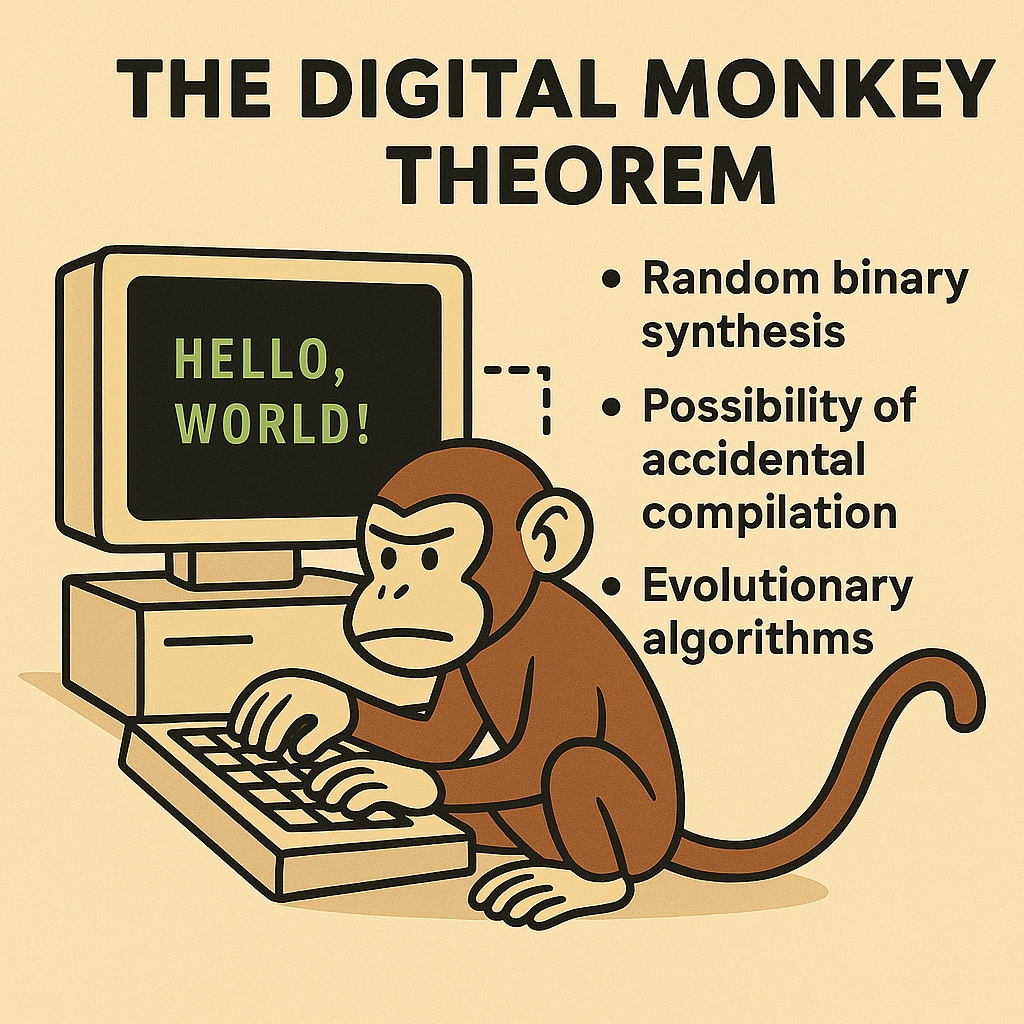
Abstract
The Infinite Monkey Theorem suggests that, given infinite time, a monkey randomly pressing keys on a typewriter would almost surely reproduce any finite text, including the complete works of Shakespeare. Inspired by this concept, this paper examines a computational analogy: that a program generating random binary sequences could, with sufficient time and resources, produce a valid MS-DOS 6.0 executable that outputs “Hello, World!”. Although the likelihood of such an event is exceedingly small, the theoretical basis rooted in probability theory, algorithmic randomness, and evolutionary computation reveals intriguing intersections between chaos and software development. Through a series of conceptual discussions and practical C# implementations, this study explores the mechanisms, challenges, and implications of accidental binary synthesis.
- Introduction
MS-DOS 6.0 executable files, particularly .COM files, are among the simplest real-world binary programs. A minimal “Hello, World!” program in MS-DOS typically comprises machine instructions that invoke interrupt 21h with AH=09h to display a string followed by a program termination.
The central hypothesis examined is:
Given sufficient time, randomness, and computational power, randomly generated bytes could, in theory, recreate a functional MS-DOS executable that outputs “Hello, World!”.
This exploration integrates concepts from probability, information theory, and evolutionary algorithms to assess the boundaries of computational creativity and the potential for emergent software structures.
- Theoretical Foundations
2.1 Infinite Randomness and Finite Output
For a binary file of length n bytes, the total number of distinct possible sequences is 2^{8n}. For a typical 100-byte .COM file, this equates to approximately 2^{800} possible combinations, an astronomically large number. While brute-force enumeration is infeasible in practice, theoretically, such a sequence will occur given infinite random generation.
2.2 Probabilistic Considerations
The probability of generating a specific n-byte binary sequence in one attempt is 1 / 2^{8n}. For shorter files, this probability is larger but still extremely small. For instance, a 27-byte file (216 bits) has a success probability of 1 in 2^{216}. With attempts numbering in the billions per second, the expected time to success exceeds the current age of the universe. Nonetheless, with infinite attempts, the probability approaches certainty.
2.3 Kolmogorov Complexity and Sequence Compressibility
The “Hello, World!” executable in MS-DOS is an example of a structurally simple and thus compressible program. According to Kolmogorov complexity, sequences with low complexity can be described by short algorithms. Consequently, the target binary is a low-complexity object, though its accidental generation remains extraordinarily improbable.
- Practical Implementation Strategies
To investigate these ideas, various C# programs simulate random binary generation and analysis:
3.1 Pure Random Generation
This approach involves generating fixed-length random byte arrays, saving them as .COM files, and comparing each to a known working binary, utilizing byte-by-byte comparison or hash functions.
3.2 Biased Generation
Instead of pure randomness, this method biases byte selection toward common MS-DOS instructions (e.g., B4 09 for MOV AH,09h; CD 21 for INT 21h; C3 for RET). This increases the likelihood that generated binaries contain valid instruction sequences.
3.3 Guided Heuristics
Further heuristics modify random bytes by inserting known strings like “Hello, World!” or ensuring proper string termination, thereby narrowing the search space while maintaining some degree of randomness.
- Evolutionary Algorithms: Enhancing Search Efficiency
To improve beyond brute-force methods, evolutionary algorithms such as genetic algorithms are utilized:
4.1 Process Overview
- Initialization: Generate a diverse population of random binary sequences.
- Evaluation: Assess each for similarity to behavior of interest (e.g., containing “Hello, World!”, valid instructions).
- Selection: Retain the top-performing individuals.
- Crossover: Combine parts of promising binaries to produce offspring.
- Mutation: Introduce slight modifications to promote diversity.
4.2 Fitness Function Design
A tailored fitness function evaluates:
- Presence of the “Hello, World!” string in output or binary code.
- Appropriate system call patterns (e.g., invoking INT 21h with correct registers).
- Structural integrity, such as executable stability (non-crashing).
- Behavioral correctness via emulators like DOSBox, analyzing output and execution behavior.
4.3 Safe Execution via Emulation
Running candidate binaries safely requires sandbox environments such as DOSBox, with automated output parsing, crash detection, and behavioral analysis to inform fitness assessments.
- Feasibility and Limitations
5.1 Pure Random Search
The sheer size of the search space makes success through pure randomness practically impossible, even with extensive computational resources.
5.2 Heuristics and Biasing
Strategies like instruction biasing and template-based generation significantly reduce the search complexity, but do not guarantee success within reasonable time frames.
5.3 Genetic Algorithms and Monte Carlo Methods
These approaches do not guarantee an optimal solution; however, they facilitate more informed navigation of the search space. Through numerous iterations, they have the potential to evolve toward partially or fully functional executable programs.
- Philosophical Implications
This exploration raises fundamental questions:
- Emergent Behavior: Can complex functionality develop from randomness when guided by appropriate criteria?
- Computational Creativity: Does the process of evolution via stochastic methods constitute a form of “creation” when it results in operational code?
- Algorithmic Evolution: To what extent can evolutionary computation approximate deliberate design?
The methodology resembles biological evolution, incorporating random variation, environmental pressures (such as fitness functions), and selection processes. In this analogy, bytes serve as hereditary units, and successful execution equates to survival.
- Future Work
- Implement complete DOS emulation to facilitate automated execution and output analysis.
- Enhance fitness functions to more accurately assess behavioral similarity to target outcomes.
- Utilize reinforcement learning techniques to direct mutations more effectively.
- Investigate neural network models trained on known .COM files to improve evolutionary efficiency.
- Conclusion
The concept that a computer could, through random processes, generate a functional MS-DOS “Hello, World!” binary is both theoretically plausible and intellectually stimulating. While the vastness of the search space presents significant challenges, this investigation provides a meaningful case study at the intersection of randomness, evolution, and computational methods.
Beyond being a technical demonstration, this thought experiment underscores the limitations of brute-force approaches, highlights the potential of probabilistic reasoning, and draws compelling parallels between digital evolution and biological processes. In this context, the “Digital Monkey Theorem” serves as a metaphor not only for automated code generation but also for the broader emergence of order from chaos across complex systems.
 Software Engineering on the Spectrum