Tag: computer science
-
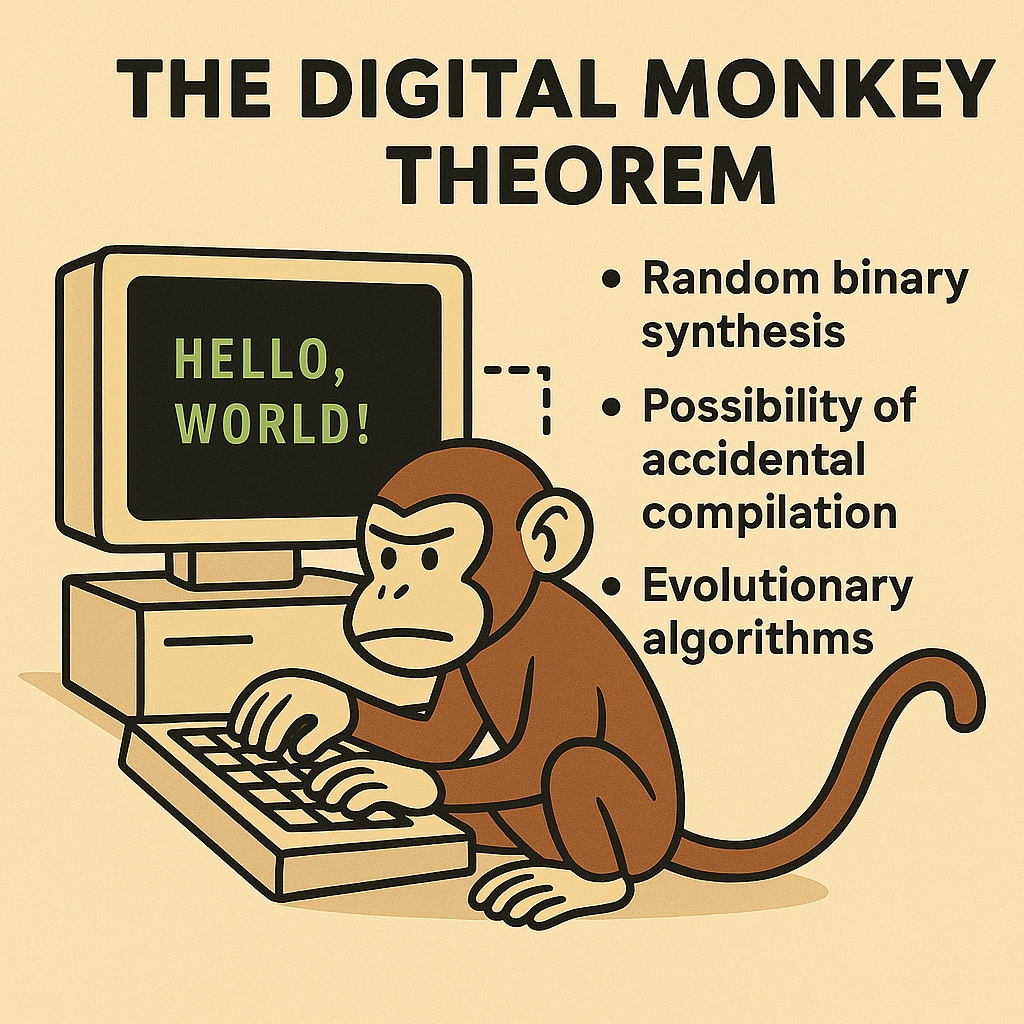
The Digital Monkey Theorem: On the Theoretical Possibility of Randomly Generating a Functional MS-DOS “Hello, World!” Executable
The paper explores the Infinite Monkey Theorem through a computational lens, positing that a program could randomly generate an MS-DOS executable to output “Hello, World!” With infinite time, while probabilities are low, the concepts of randomness, chaos, and software evolution are examined, integrating practical implementations and evolutionary algorithms to navigate this complex exploration.
-

The Relationship Between CPU Design and Programming Language Theory Over the Past 50 Years
The essay explores the dynamic interplay between CPU design and programming language theory over fifty years. It traces developments from the 1970s to present, highlighting milestones such as structured programming with C, RISC architectures, and multicore processors. This evolving relationship has continuously influenced software optimization and hardware advancements, fostering innovation.
-

Blocky’s Big Clean-Up: How Computers Organize Crazy Piles
Quicksort is a fast sorting method where a “helper block” guides the organization of blocks into smaller and bigger groups. By repeatedly dividing the piles and selecting new helper blocks, the sorting process becomes efficient. This technique quickly organizes the blocks from smallest to largest, resembling a collaborative sorting game.
-

The Evolutionary Lineage of Computational Thinking
The content explores the evolution of computational thinking through key innovators like Alan Turing, Grace Hopper, Edsger Dijkstra, Dennis Ritchie, Ken Thompson, Donald Knuth, Barbara Liskov, and Linus Torvalds. Their contributions illustrate how technology advances cumulatively, transforming abstract theories into practical applications and collaborative frameworks, highlighting human ingenuity and collaboration.
-

The Origins of Strongly Typed Programming Languages and Their Impact on Software Engineering
The evolution of strongly typed programming languages has transformed software engineering, emphasizing type safety and compile-time error detection. Originating from ALGOL, Pascal, and ML, these languages enhance reliability and maintainability in software. Their influence extends to advanced type systems and tools, shaping contemporary development practices and addressing increasing software complexity.
-

Conway’s Game of Life: From Mathematical Curiosity to Software Engineering Paradigm
In 1970, John Horton Conway introduced the Game of Life, a cellular automaton exhibiting complex behaviors from simple rules. The game significantly influenced software engineering by exemplifying declarative programming, emergence, and parallel processing. Its cultural impact spans multiple disciplines, continuing to inspire exploration and innovation in computing decades later.
-

Using LINQ and C# to Evaluate Yahtzee Dice Throws
When game logic intersects with contemporary programming paradigms, remarkable results can be achieved. This essay examines how C#’s LINQ features can effectively address the challenge of evaluating Yahtzee dice throws. By converting intricate pattern recognition and scoring rules into organized, functional code, we will illustrate how LINQ’s declarative style enhances clarity, which may otherwise be…
-

Exploring Recursion with LINQ and C#
Language-Integrated Query (LINQ) in C# provides developers with a robust set of tools for data querying and manipulation. Although LINQ does not inherently support recursion, innovative methods can be employed to achieve this functionality. This article examines the concept of recursive LINQ, illustrating how to implement recursive behavior through LINQ methods in C#. This approach…
-

Programming Language Theory: The Foundation of Modern Software Engineering
Exploring the theoretical foundations that have transformed software development, I am pleased to present a comprehensive examination of Programming Language Theory (PLT) and its significant influence on software engineering. From lambda calculus to contemporary type systems, this exploration highlights how theoretical frameworks have shaped the tools and languages that are integral to our daily work.…
-

The Linked List Interview Question: A Rite of Passage
Have you ever found yourself at a whiteboard during a technical interview, with a marker in hand, tasked with implementing a linked list in Pascal? This fundamental data structure, despite its historical significance, continues to serve as an effective evaluation tool for software engineering candidates. But what explains the lasting relevance of this particular challenge?…
 Software Engineering on the Spectrum