Tag: programming language design
-

The Origins of Strongly Typed Programming Languages and Their Impact on Software Engineering
The evolution of strongly typed programming languages has transformed software engineering, emphasizing type safety and compile-time error detection. Originating from ALGOL, Pascal, and ML, these languages enhance reliability and maintainability in software. Their influence extends to advanced type systems and tools, shaping contemporary development practices and addressing increasing software complexity.
-
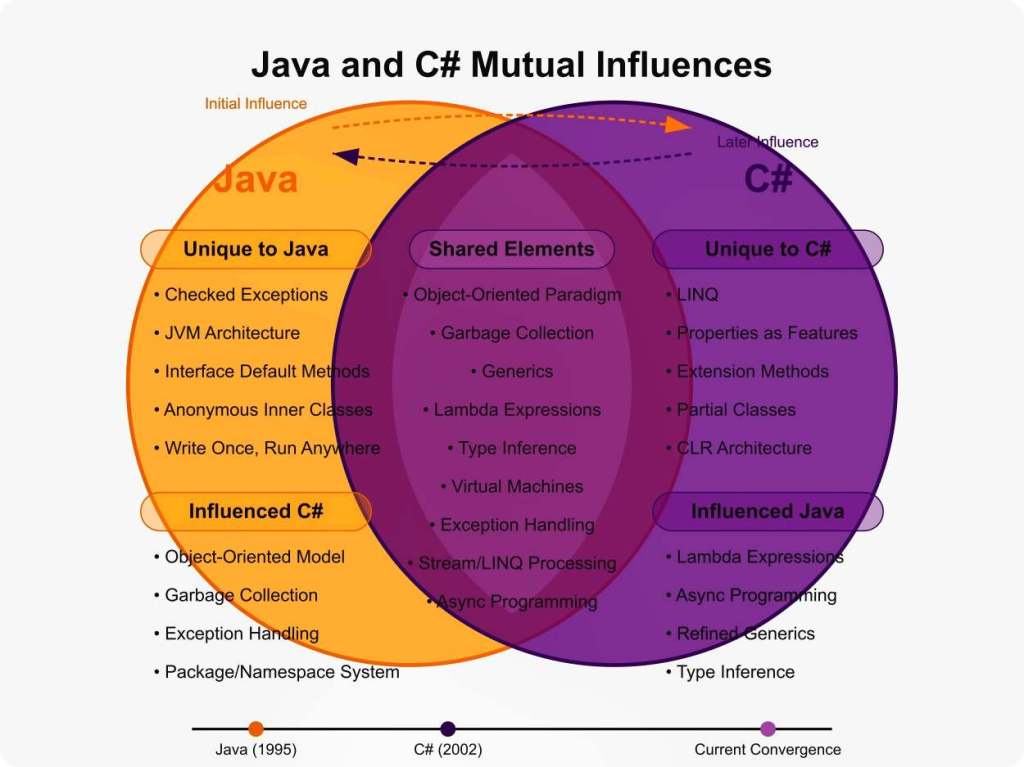
Technical Comparison of Java and C#: Mutual Influences
Java and C# are influential programming languages that have shaped each other through reciprocal borrowing of features and design principles. This document explores their evolution, technical traits, and parallel advancements, highlighting how concepts like object-oriented programming, generics, and functional programming have developed and converged, benefiting developers across both ecosystems.
-

Null Values in Programming Languages: Concepts, History, Initial Languages, Pros, Cons, and Modern Impact
Null values are essential in programming, indicating the absence of valid data. While simplifying tasks like memory management, they can lead to significant errors, termed the “billion-dollar mistake” by Tony Hoare. This analysis explores null’s origins, advantages, disadvantages, and influence on modern programming practices, highlighting the shift towards safer coding paradigms.
-

Ingenious Programming Language Features Lost in Time
Programming languages have evolved significantly, with modern languages like Python and JavaScript emphasizing readability. However, many innovative features from older languages, such as APL’s concise notation and Prolog’s declarative logic, have been overlooked due to their complexity or limited adoption. Revisiting these aspects might inspire new solutions to contemporary challenges.
-

The Transformative Journey of BASIC’s READ and DATA: A Comprehensive Historical Perspective
In the 1960s, BASIC emerged to simplify programming, particularly through its READ and DATA commands. These concepts influenced subsequent languages, promoting data accessibility. As computing evolved, they contributed to modern techniques in configuration management and data handling, demonstrating the lasting impact of early innovations on contemporary programming practices.
 Software Engineering on the Spectrum