Tag: software engineering
-

The Role of Curiosity in Technological Innovation
In software engineering, technical skills are foundational, but curiosity distinguishes professionals. This trait drives exploration, pushing engineers to question and innovate beyond standard practices. Curious engineers actively engage with technology, fostering continuous learning and problem-solving. They integrate insights from various disciplines, promoting holistic solutions and sustainability, making them essential in a rapidly changing tech landscape.
-

My Key Ingredients for Success as a Software Engineer: Mindfulness, Empathy, and Gratitude
The content emphasizes that alongside technical skills, personal qualities like mindfulness, empathy, and gratitude are essential for success in software engineering. Mindfulness helps in decision-making and stress management, empathy fosters effective collaboration and understanding user needs, while gratitude promotes a positive work environment and encourages growth.
-

The History of Time-Sharing in Computing and the Evolution of Code Optimization
The history of time-sharing in computing highlights significant advancements and economic considerations. Originating in the late 1950s, it enabled simultaneous computer access for multiple users, necessitating highly optimized code. Although optimization declined with improved hardware, the rise of cloud computing has renewed this focus, aiming for efficiency and cost-effectiveness in resource utilization.
-
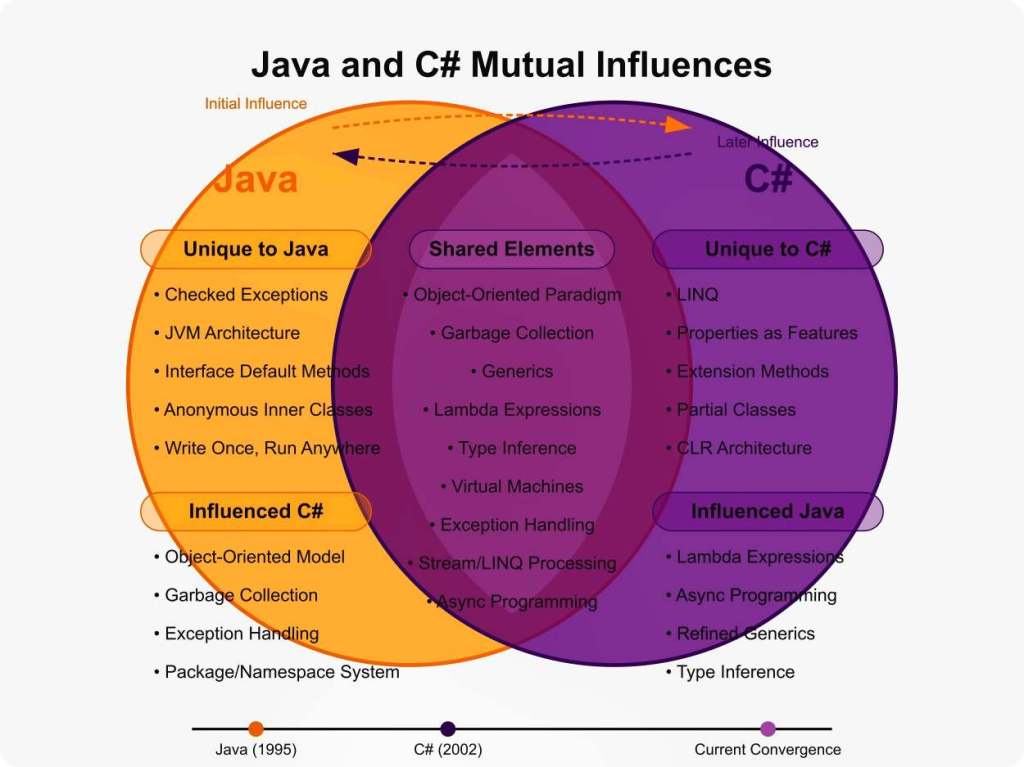
Technical Comparison of Java and C#: Mutual Influences
Java and C# are influential programming languages that have shaped each other through reciprocal borrowing of features and design principles. This document explores their evolution, technical traits, and parallel advancements, highlighting how concepts like object-oriented programming, generics, and functional programming have developed and converged, benefiting developers across both ecosystems.
-

Null Values in Programming Languages: Concepts, History, Initial Languages, Pros, Cons, and Modern Impact
Null values are essential in programming, indicating the absence of valid data. While simplifying tasks like memory management, they can lead to significant errors, termed the “billion-dollar mistake” by Tony Hoare. This analysis explores null’s origins, advantages, disadvantages, and influence on modern programming practices, highlighting the shift towards safer coding paradigms.
-

From Atari to Micro SD: A Personal Journey Through Storage Density and Software Evolution
From the moment I unboxed my Atari 2600 in 1978 to the day I inserted a 256GB micro SD card into my Nintendo Switch, I have observed a significant evolution in storage density that has fundamentally transformed the field of software engineering. What began with the 2KB limitations of *Breakout* has evolved into an era…
-

Conway’s Game of Life: From Mathematical Curiosity to Software Engineering Paradigm
In 1970, John Horton Conway introduced the Game of Life, a cellular automaton exhibiting complex behaviors from simple rules. The game significantly influenced software engineering by exemplifying declarative programming, emergence, and parallel processing. Its cultural impact spans multiple disciplines, continuing to inspire exploration and innovation in computing decades later.
-

The Evolution of Search Algorithms: From Text to Tomorrow
Search algorithms have evolved significantly from simple brute-force methods to advanced systems capable of efficient information retrieval. Key milestones include the Knuth-Morris-Pratt and Boyer-Moore algorithms, tree-based structures like B-trees, and modern innovations such as locality-sensitive hashing and embedding-based retrieval. The future holds promise for personalized, multimodal, and privacy-preserving search technologies.
-

The Homebrew Computer Club: Catalyst for a Generation of Software Engineers
The Homebrew Computer Club, founded in 1975, catalyzed a technological revolution by fostering innovation among early computer enthusiasts. It influenced Generation X, making technology accessible and inspiring software pioneers like Steve Jobs and Bill Gates. Its legacy of meritocracy and creativity continues to thrive in today’s tech culture, shaping future generations.
-

Using LINQ and C# to Evaluate Yahtzee Dice Throws
When game logic intersects with contemporary programming paradigms, remarkable results can be achieved. This essay examines how C#’s LINQ features can effectively address the challenge of evaluating Yahtzee dice throws. By converting intricate pattern recognition and scoring rules into organized, functional code, we will illustrate how LINQ’s declarative style enhances clarity, which may otherwise be…
 Software Engineering on the Spectrum