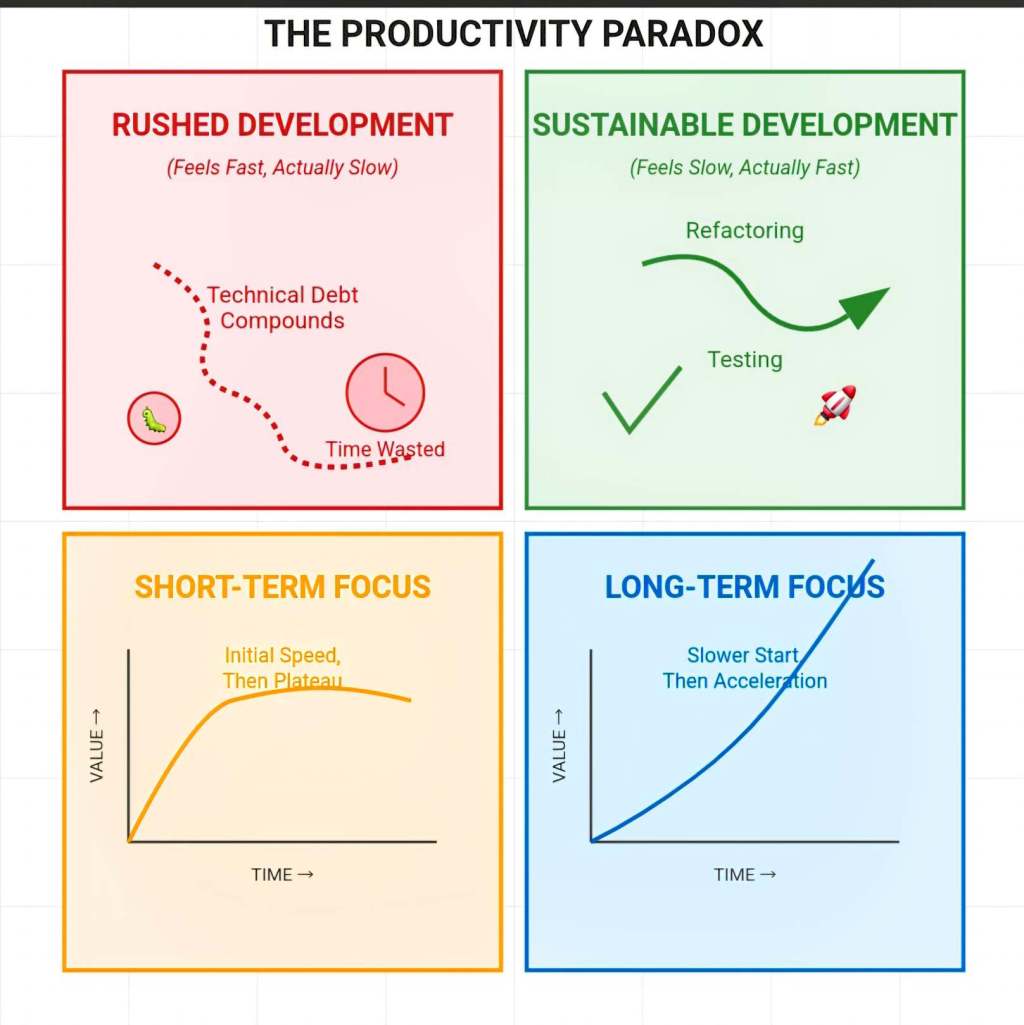
When developers encounter concepts such as refactoring and testing, they often perceive these practices as time-consuming activities that postpone feature delivery. However, this perspective is misleading: what may seem like a slowdown is actually a more effective strategy for progress. Once you genuinely embrace this idea, you will no longer feel the need to advocate for “refactoring time,” as you will recognize it as the most efficient path in development.
The Pitfalls of Rushing
While taking swift action without refactoring or testing may appear productive in the short term—resulting in code shipments, ticket closures, and apparent progress—this approach leads to an accumulation of technical debt over time, much like financial debt with increasing interest.
The repercussions become apparent when:
- Bug fixes take progressively more time
- Implementing new features grows increasingly challenging
- Simple adjustments begin to risk destabilizing existing functionality
- Onboarding new team members requires weeks instead of days
What initially seems like “moving fast” eventually evolves into a cumbersome process.
The Time-Saving Benefits of Refactoring
Refactoring involves reorganizing existing code while maintaining its external functionality. Rather than being a mere indulgence, it is a strategic investment that yields significant returns:
Reduced cognitive load: Well-structured code requires less mental effort to comprehend, facilitating faster feature development and minimizing errors.
Improved maintainability: Logically organized code allows for quicker identification and resolution of bugs.
Enhanced extensibility: Code that has been effectively refactored is more modular and adaptable, simplifying future feature implementations.
Decreased onboarding duration: New team members are able to contribute more rapidly when engaging with clean code.
The Time-Saving Benefits of Testing
In a similar vein, while writing tests may seem like an additional task, the long-term time savings are considerable:
Earlier bug identification: Detecting issues during development is significantly less costly than addressing them in production.
Safer modifications: Tests provide assurance that changes will not disrupt existing functionality, alleviating the uncertainty often associated with complex codebases.
Improved design: Writing code with testability in mind promotes better architecture and clearer separation of concerns.
Reliable documentation: Tests function as executable documentation that remains relevant, saving considerable time during knowledge transfer.
Shifting Mindset
The critical transformation occurs when you transition from viewing refactoring and testing as competing with “real work” to recognizing them as catalysts for acceleration. This shift is not about striving for perfection; it is about enhancing efficiency.
Once you have experienced the stark contrast between working with well-structured, tested code versus a fragile, untested codebase, the productivity advantages become increasingly clear. At that point, you will no longer need to justify these practices to management; you will understand that neglecting them ultimately hampers progress.
Practical Implementation
This does not imply spending excessive time on extensive refactors prior to introducing features. Instead, consider the following approach:
- Make incremental improvements as you progress
- Write tests for new features and during bug fixes
- Adhere to the Boy Scout Rule: leave the code in a better state than you found it
- Prioritize addressing the areas where improvements will yield the greatest productivity gains
Conclusion
The most effective developers recognize that maintaining code quality through refactoring and testing is essential—not a luxury. It represents the most reliable method for consistently delivering value over time. By truly embracing this mindset, you will no longer need to negotiate for time to enhance code quality, as it will become evident that this approach is simply the most efficient for development.
The paradox becomes clear: investing time to do things correctly is indeed the quickest route to progress.
 Software Engineering on the Spectrum